
Start with your home university's international or exchange office: they nominate you and set the application route, so contact them first. Once you know your nomination deadline, confirm your department's eligibility rules, request a copy of your transcript, and sketch a short study plan outlining which courses you want abroad. These three steps determine whether you can apply at all.
TL;DR:
- Most exchange programs require nomination from your home university's international office before applying and submitting supporting documents.
- Eligibility depends on your enrollment status, minimum study time, GPA, subject-specific requirements, and departmental quotas, not just application forms.
- The application process involves mapping courses for credit transfer, obtaining nominations, then completing the host application with transcripts and study plans, all within strict deadlines.
- Visa requirements vary by country and depend on your nationality and program length, with formal sponsorship documents needed before applying for a visa.
- Budgeting should include full costs like tuition, travel, accommodation, insurance, and other expenses, not just the program fees, with some funding options available.
Table of Contents
- Types of exchange programmes and who they suit
- Who can apply: eligibility and academic requirements
- The application sequence, step by step
- Documents you need and how to write a study plan
- Deadlines and a realistic timeline
- Visas and immigration basics
- Budgeting for the full cost, not just tuition
- Safety and safeguarding for younger students
- Choosing the right programme: a decision checklist
- A final word from the author
- How Go Study Ireland supports your application and travel
- Where to verify the official rules
- Sources
- FAQ
Types of exchange programmes and who they suit
Before you contact anyone, work out which category you fit. The application route, required documents and even the visa process change depending on the programme length and your age.
- Short-term and summer programmes: typically two to six weeks, aimed at secondary students aged around 10 to 18, often run through summer camps or school-exchange partnerships.
- Semester exchanges: one term abroad, common for both upper secondary and university students, usually needs partial credit transfer.
- Full academic-year placements: a full year at a partner school or university, the most common route for students seeking complete immersion and full credit recognition.
- Work-study and gap-year programmes: aimed at students after secondary school or during a break from university, combining paid or voluntary work with study.
Tertiary students generally go through their university's international office, while secondary students usually apply through a school partnership or a managed provider. Each track has its own eligibility checks and, for minors, extra safeguarding requirements.
Who can apply: eligibility and academic requirements
Eligibility depends first on where you are enrolled. According to Erasmus+ guidance, higher-education exchange eligibility covers short-cycle, Bachelor's, Master's and doctoral students registered at participating institutions, and there is no central application form: you apply through your home institution's international or Erasmus+ office, which manages selection and nominations.
Beyond enrolment, most programmes set additional conditions:
- Minimum completed study time, often a full year or a set number of credits before you can apply.
- Grade or GPA thresholds set by the department or the partner agreement, not by the exchange office alone.
- Subject-specific requirements, such as portfolios for art and design students or language certificates for humanities placements.
- Departmental caps, since many partner agreements reserve only a handful of places per subject area each year.
Applying directly to a host institution without a nomination rarely works on partner-only exchange routes. The home institution controls eligibility and nomination, so skipping that step usually means missing the place entirely.
The application sequence, step by step
Once you know your programme type and eligibility, the process follows a fairly fixed order, though exact steps vary by institution.
- Map your academic plan first. Check with your department which courses abroad will count towards your degree and confirm credit compatibility before you fall in love with a destination.
- Request nomination from your home international office. This must happen before the internal deadline; many institutions let you rank several partner choices if you are not fixed on one destination.
- Wait for confirmation of nomination, then complete the host institution's own application form, uploading transcripts, language evidence and your study plan.
- Arrange post-offer steps once the host accepts you: credit approval from your home department, insurance, housing and visa or immigration paperwork.
This mirrors the general pattern described in university exchange application guidance, which lists destination research, eligibility checks, home nomination, host application, and then credit approval, insurance, housing and visa preparation as the standard sequence, though procedures and deadlines differ between institutions.
Pro Tip: Keep a single document tracking every deadline, from nomination to visa appointment. Missing the nomination window is the single most common reason students lose their place.
Documents you need and how to write a study plan
Most applications ask for a similar core set of paperwork, though hosts sometimes add subject-specific extras.
- Academic transcript showing grades and completed credits to date.
- Proof of enrolment at your home institution.
- Passport copy, with the name matching exactly what appears on other documents.
- Language proficiency evidence, a certificate or an institutional letter.
- Learning agreement or study plan mapping proposed courses to your home degree.
- Motivation statement, and a portfolio where the subject requires one.
A strong study plan does more than list modules. It should explain how each course fits your degree requirements, note the credit weighting and workload, and include one or two alternate courses in case your first choices are full. Hosts and home departments both use this document to approve or refuse credit transfer, so vague or mismatched plans are a common cause of delay.
Deadlines and a realistic timeline

Nomination and host application deadlines are almost always separate, and visa and housing deadlines follow later still. Examples from institutions such as Malmö, UTS and Åbo Akademi show nomination windows closing months before the host application opens, according to staged deadline guidance.
A typical semester or year-long exchange timeline looks roughly like this:
- Six to nine months before departure: confirm eligibility, request nomination, book any required language test.
- Four to six months before: submit the host application with transcripts and certified translations.
- Two to four months before: complete visa application once accepted, arrange housing and insurance.
- Four to six weeks before: confirm travel, orientation dates and final paperwork with the coordinator.
Follow up with coordinators at each stage rather than waiting for silence to mean approval.
Visas and immigration basics
Visa and immigration rules depend on your nationality, destination, age and programme length, and acceptance or sponsor documents usually come before the visa application itself. EducationUSA's five-step guidance explains that after acceptance, the sponsoring US institution issues eligibility documents, such as Form DS-2019 for J exchange visas, and visa preparation follows from there.
- United States: F-students receive Form I-20, while exchange visitors on J visas receive Form DS-2019, both issued only after acceptance.
- United Kingdom: official immigration guidance distinguishes the Student route from the Child Student route for younger learners, and treats study-abroad arrangements as a separate case with their own conditions.
- European Union: acceptance evidence and enrolment confirmation from the host institution generally form the basis of any visa or residence permit application.
Immigration permission is destination-specific, and the UK's official guidance states that study-abroad arrangements are assessed case by case, so applicants must check the current rules for their own circumstances rather than relying on general advice.
Make sure your passport name matches your acceptance letter exactly and build in extra weeks for processing and any visa interview.
Budgeting for the full cost, not just tuition
Programme fees are only one line in the budget. According to Karolinska Institutet's exchange guidance, costs vary by destination, duration and what the provider includes, so there is no single global figure, and students should budget for the whole trip rather than tuition alone.
- Programme or tuition fees, plus travel to and from the destination.
- Accommodation, food and local transport for the full stay.
- Insurance and visa costs, including any required medical cover.
- Deposits and an emergency fund for unexpected expenses.
Funding often comes from institutional scholarships, exchange-specific bursaries or government grants, and some destinations allow limited part-time work. Minors typically need a parent or guardian to provide a financial guarantee as part of the application.
Safety and safeguarding for younger students
For anyone under 18, safeguarding checks are not an afterthought, they are part of the application itself. Before booking, verify who vets host families, who holds the named safeguarding contact role, and how emergency and medical situations are handled.
- Ask who vets host families and how often those checks are renewed.
- Confirm a named 24/7 contact for emergencies, not a general office line.
- Check how medical or special-needs requirements are recorded and shared with the host.
- Ask what documentation covers parental consent and guardianship for travel abroad.
Go Study Ireland structures its placements around this kind of oversight, offering 24/7 local support, vetted host families and end-to-end management of visas and accommodation across programmes including the Academic Year Spain placement and its academic-year and summer camp offerings.
Pro Tip: Ask any provider or host institution for their safeguarding policy in writing before you pay a deposit, not after.

Choosing the right programme: a decision checklist
With eligibility confirmed and documents ready, weigh your options against a short list rather than picking on destination alone.
- Academic fit and credit recognition come first: confirm your home department will accept the credits before anything else.
- Language requirements and duration next, matched against your own proficiency and how long you can realistically be away.
- Accommodation and support arrangements, including who handles problems if something goes wrong locally.
- Cost and funding compatibility, checked against scholarships or grants you can actually access.
- Deadlines, since a perfect programme with a missed nomination window is not an option at all.
Use every ranked choice your institution allows, confirm departmental caps before you commit emotionally to one destination, and ask for early credit pre-approval in writing.
A final word from the author
Start earlier than feels necessary. Nomination deadlines close quietly, often a full academic term before the host application even opens, and the students who miss out are usually the ones who assumed there was more time. Contact your international office this week, not next month, and use the checklist above as your working document rather than a one-time read.
Managed support exists for families who want help with the logistics rather than handling every form alone, and pages such as the University Placement service outline how that kind of guidance works in practice.
— Eugeni
How Go Study Ireland supports your application and travel
Go Study Ireland handles the parts of an exchange application that cause the most stress: matching you to a suitable programme, managing visa and accommodation paperwork, and providing 24/7 local support once you arrive.
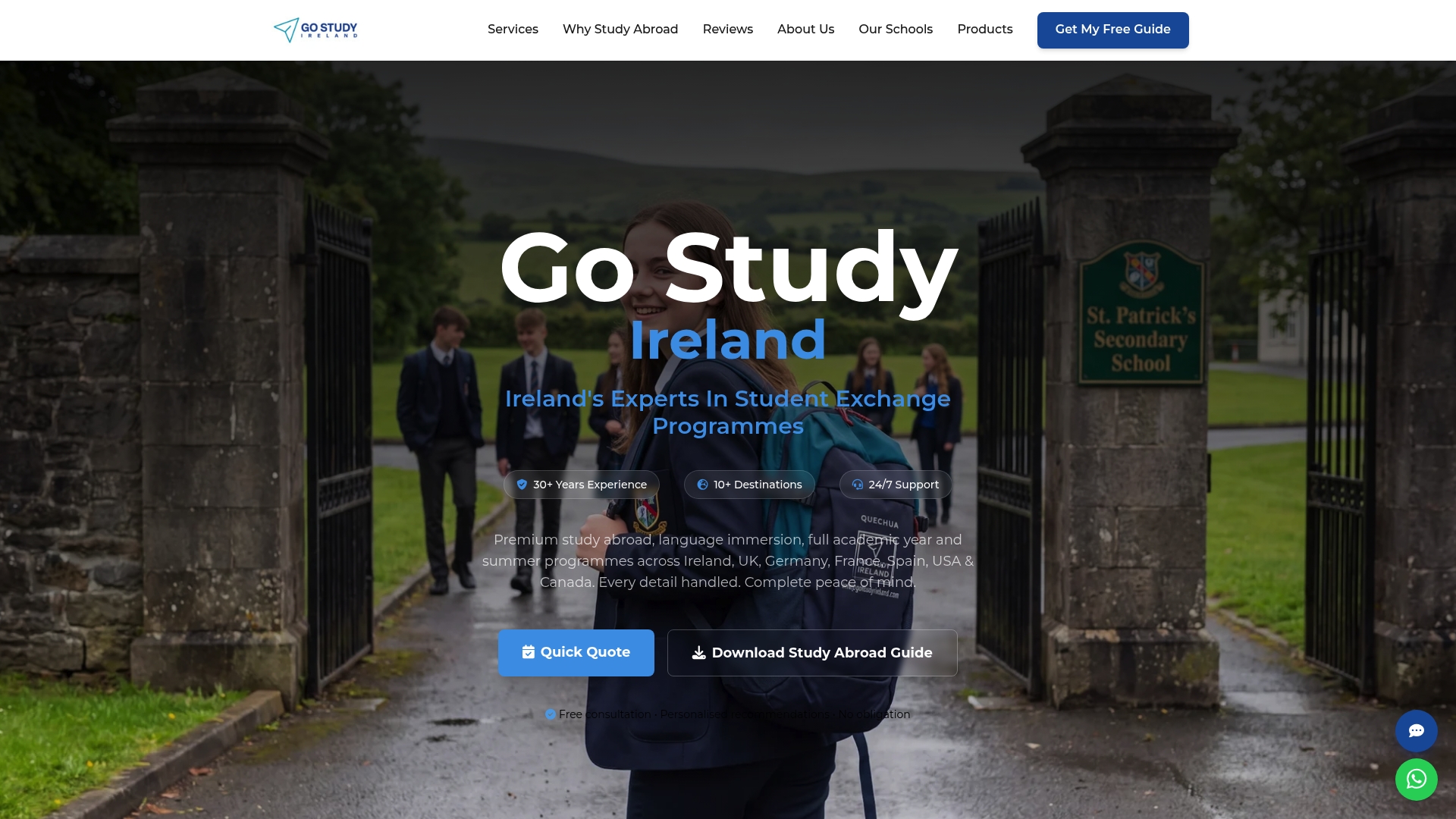
- Academic-year placements in Ireland and the UK, with school lists and full logistics handled by dedicated staff.
- Summer camps in Cork, Dublin and Limerick, and in Bath and Leeds for 2027, suited to shorter programmes.
- University placement consulting for students who need help matching courses and credit transfer.
- Personalised programme matching and vetted host families, addressing the safeguarding concerns covered above.
If a full academic year fits your plan, the Academic Year in Ireland and Academic Year in the United Kingdom pages set out school options and what is included. For shorter stays, the summer camp programmes are a practical starting point, and the team can talk through which route suits your timeline and budget.
Where to verify the official rules
Always check primary sources before finalising your application, since rules change and vary by country and institution.
- Erasmus+ for EU exchange eligibility and nomination procedures.
- EducationUSA for US application and visa document sequencing.
- GOV.UK immigration guidance for UK Student and Child Student route rules.
- Your own university's exchange office pages for institution-specific deadlines and partner lists.
Sources
- Studying abroad - Erasmus+
- How to apply — University of Copenhagen guidance (illustrative sequence)
- Your five steps to study in the United States — EducationUSA
- Gov
FAQ
How do you get to be an exchange student?
You start by contacting your home institution's international or exchange office, since they handle nomination and set the eligibility rules for partner destinations, as explained in Erasmus+ guidance. Once nominated, you complete a separate application with the host institution, including your study plan and supporting documents.
How much money do you need to be an exchange student?
Costs vary by destination, duration and what the programme includes, so there is no single figure that applies everywhere, according to Karolinska Institutet's guidance. Budget for tuition or programme fees, travel, accommodation, insurance, visa costs and an emergency fund rather than tuition alone.
How much does it cost to be an exchange student?
The total cost depends on the country, programme length and provider, with no universal figure available, as noted in exchange budgeting guidance from Karolinska Institutet. Programme fees, living costs, insurance and visa charges should all be added together for a realistic estimate.
Can a 12 year old be an exchange student?
Younger students typically join through school-based or summer programmes rather than university exchanges, which generally require secondary or tertiary enrolment. Programmes for younger children usually involve extra safeguarding steps, including host-family vetting and named emergency contacts, before enrolment is confirmed.