
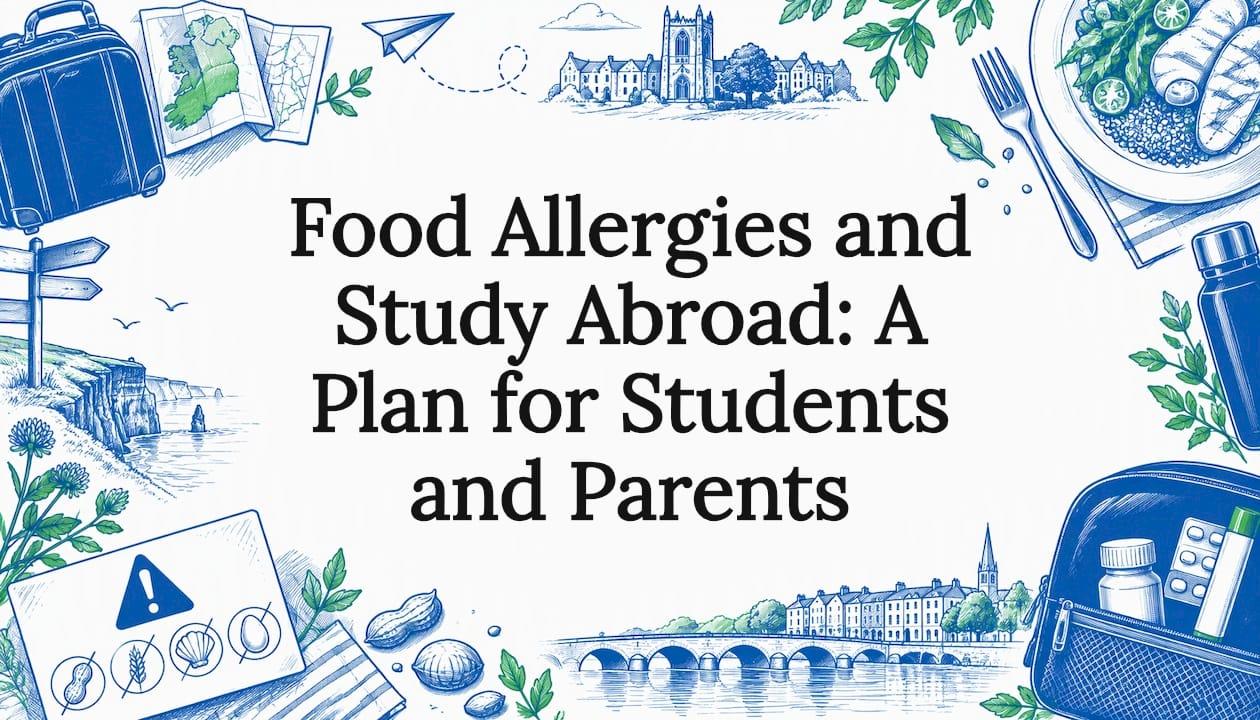
A food allergy does not rule out a summer camp, a school exchange or an academic year abroad. It does mean the planning starts earlier and covers more people. The families who manage it best tell the organiser early, agree who does what if a reaction happens, carry the right medication and prepare the student to speak up in another language. This guide walks through each step, with the questions to put to any programme before you pay a deposit.
TL;DR
- Tell the programme about every allergy as soon as you enquire, not after booking. Advisors, camp staff and host families can only plan around what they know.
- Agree in writing who keeps the medication and action plan, who answers allergy questions, and who goes to hospital with the student.
- Carry adrenaline devices in hand luggage, with enough medication for the whole stay plus spares, and a doctor's note for the flight.
- Learn the allergy phrases in the host language and carry translation cards.
- For homestays, check the meal plan, kitchen habits and distance to a hospital, and have a final meeting before departure.
Table of Contents
- Start with the organiser, early
- What to weigh when comparing destinations and programmes
- Agree the plan with everyone involved
- Language: explaining an allergy in another country
- Travel day: flights, medication and carry-on
- Summer camps: tell staff before the first day
- Academic years and homestays: everyday food, every day
- If a reaction happens abroad
- Our perspective
- Our programmes
- FAQ
- Sources
Start with the organiser, early
The first step is the simplest. Allergy guidance for students travelling overseas says to share your allergies with the study abroad or exchange advisor before the trip, along with learning key phrases, bringing allergy cards and carrying medication and safe snacks.
For school trips, Allergy & Anaphylaxis Australia advises parents to start planning as soon as a trip is known and to ask what the school's plan is for keeping a child with food allergy safe, including whether the trip is suitable or whether changes are possible. The same applies to a private programme: the earlier the conversation, the more options there are.
When you first get in touch, have this ready:
- The exact allergens, and whether the student reacts to traces or only to the food itself.
- The reaction history: what symptoms, how fast, what treatment was needed.
- The current allergy action plan from the student's doctor.
- The medication prescribed and who has been trained to use it.
- What the student can do for themselves, such as reading labels, asking about ingredients and self-injecting.
On our side, personalised programme matching starts from this kind of detail. A student with a dairy allergy and a student with a nut allergy may well belong in different placements, so tell us everything at the start.
What to weigh when comparing destinations and programmes
Allergy & Anaphylaxis Australia lists the details that should feed into a decision about a trip: itinerary, countries visited, trip length, days in each place, inter-city transport, whether students will be in remote areas or large cities, and the airline, because airlines differ in their food allergy policies. The same source suggests asking about the accommodation type, its distance from a hospital, the meal plan and whether there is refrigeration for your own food.
Translated into questions for a study abroad provider:
| Area | What to ask | Why it matters |
|---|---|---|
| Accommodation | Host family, residence or camp dormitory? How far is the nearest hospital? | Determines who prepares food and how fast help can arrive. |
| Meals | Who cooks, what is the meal plan, can the student keep and refrigerate their own food? | Shows how much control the student has over what they eat. |
| Staff | Who on site understands allergies and can act on an emergency plan? | A named adult is better than a general promise. |
| Excursions | Do day trips include meals in restaurants, and who checks them? | Outings are where routines break down. |
| Emergencies | Which number do we call, and who accompanies the student to hospital? | Settles responsibility before it is needed. |
| Travel | Which airline, and what is its allergy policy? | Policies differ between carriers. |
A good provider answers these without fuss. Where you can, get the answers in an email, so everyone is working from the same page.
Agree the plan with everyone involved
The most useful single habit is a final meeting before departure. Allergy & Anaphylaxis Australia recommends one between school, parents and student to confirm where the medication and action plan will be kept, who will help with allergy questions and restaurant staff, and who will respond to a reaction and go with the student to hospital.
For a private programme, the "school" in that sentence becomes the organiser, camp leader or host family. The US charity FAACT adds two principles worth borrowing. Trips should be inclusive, so a student is not excluded because of their condition, and they should involve a designated person who fully understands allergies, can recognise the signs of a reaction and can carry out emergency action plans. FAACT also says parents should work with trip coordinators to avoid high-risk destinations when planning.
Write down, and share with the student:
- Who the student tells first if they feel unwell.
- Who follows the action plan and gives adrenaline.
- Who goes with them to hospital.
- Where the medication is kept, and that the student carries it themselves.
- Who the parents call, at any hour.
If your child is on a school group trip, our guides on planning a short school trip abroad and a school trip safety checklist cover the wider arrangements that sit around the allergy plan.
Language: explaining an allergy in another country
A student who can say "I am allergic to peanuts, even a trace can make me seriously ill" in the local language is far better placed than one who relies on pointing at a menu. The advice from study abroad offices is to learn simple allergy phrases in the host-country language and bring allergy cards in other languages to show restaurant staff.
A practical routine:
- Learn the words for each of the student's allergens, written and spoken, plus "allergy", "ingredients" and "may contain".
- Carry printed or saved translation cards listing the allergens and the need to avoid cross-contact.
- Practise saying the key sentence aloud before leaving, not only reading it.
- For English-speaking destinations such as Ireland or the UK, still carry a short written card. Staff in a busy kitchen respond faster to something they can read.
Cross-contact deserves its own line on the card: shared fryers, chopping boards and serving spoons are where a safe dish becomes an unsafe one.
Travel day: flights, medication and carry-on
The journey is where small mistakes happen, mostly around medication. The guidance from allergy organisations is consistent.
Medication quantity. ASCIA, the Australasian allergy society, says people at risk of anaphylaxis should take enough medication for the whole trip, plus extra in case of delays, loss or the need for a higher dose, and make sure nothing expires during travel.
Where the adrenaline goes. The same checklist says adrenaline devices, if prescribed, should always be carried with you and not packed in checked luggage or stored in overhead lockers, because they must be instantly accessible. For a long stay, Allergy & Anaphylaxis Australia says travellers should carry at least two adrenaline devices and an action plan, tell others where they are kept and how to use them, and find out emergency numbers and available medical services in each country visited.

Doctor's note and airline. FoodAllergy.org advises getting a note from your allergist or doctor in case you need to verify that you are taking an epinephrine injector on the plane, and checking the airline's policies in advance.
On board. The same page suggests boarding early, wiping down the tray and seat, packing a meal and safe snacks, and keeping a small bag with medicines and extra snacks within reach.
If your child is under 16 and flying alone, read our guide to unaccompanied minor flights well before booking, since airline rules affect both the allergy plan and who meets your child at the other end.
Summer camps: tell staff before the first day
Camp is a different setting from school, and the paperwork does not simply carry over. FoodAllergy.org advises notifying camp staff early through the application or health form, using an emergency care plan that lists the foods and typical symptoms. It also warns not to just transfer school documentation to camp, since camp is different and specific camp personnel need to be authorised and instructed.
For a summer camp in Ireland or the UK, that means:
- Declaring the allergy on the booking and health forms, with the action plan attached.
- Confirming who among the camp leaders is briefed, and who holds the medication during activities, excursions and overnight.
- Asking how meals are arranged on day trips and whether the student can bring safe snacks.
- Asking for the plan to be repeated at arrival, face to face, with the student present.
Our camps run in Ireland, in Cork, Dublin and Limerick, and in England for 2027, in Bath and Leeds. Whatever the location, the best time to discuss an allergy is before you choose the camp, because it can influence which one suits your child.
Academic years and homestays: everyday food, every day
A two-week camp is one thing. Ten months in a host family means hundreds of meals cooked by someone who is not a parent. That is where clear, kind communication counts most.
Before placement, ask:
- Will the family be told about the allergy in detail before they agree to host?
- Does the family cook for the student, or will the student prepare some meals? Is there space in the fridge and cupboards for their own food?
- How does the family handle label reading and cross-contact?
- Has the family met the student's emergency plan, and do they know how to use the adrenaline device?
- Who can the student phone at night, and how quickly can someone reach the home?
A host family who says "just tell us what to avoid" is often a good sign. A family who wants to see the action plan and rehearse it is better still. Read more about how placements work in our guide to living with a host family, and, should the match not work out for any reason, changing host family explains the process. For under-18s studying in the UK, guardianship is another layer of care to understand early. Our wider piece on study abroad safety covers the programme checks that apply to every student.
Help your child build independence in the months before departure. A teenager who already reads labels, phones restaurants ahead and carries their own kit will settle in faster, and will be a more confident self-advocate at the family dinner table.
If a reaction happens abroad
The time to settle this is before departure. Agree who the student tells, who gives adrenaline, and who goes to hospital with them, as set out above. Add three practical items:
- Emergency numbers for the destination country, saved in the student's phone and written on the action plan.
- The address of the nearest hospital to the accommodation, which the student and host family both know.
- A copy of the action plan in English and, where relevant, the local language, kept with the medication.
Families should also make sure that the people around the student, including travel companions, know the signs of a reaction and how to use the devices. Student travel guidance recommends that companions learn the signs and the device technique before the trip.
Your own doctor or allergist is the right person to confirm the medication, doses and written action plan. Ask them for a letter and a plan that suits the specific country and length of stay.
Our perspective
We have placed thousands of students abroad, and the families who worry most about food allergies are usually the ones who prepare best. That is a strength, not a problem.
Our view is simple. A food allergy is a planning variable, like a visa or a school timetable, and it is one we want to know about from the first enquiry. Our approach is built around personalised matching, carefully vetted host families and 24/7 local support, and each of those works better when we have the full picture. The earlier we hear about an allergy, the more thoughtfully a placement can be matched.
We also manage the logistics families usually carry alone: visas, accommodation, school placement. That frees parents to spend their energy on the conversations that matter most, with the student, with the host family and with the doctor.
Students with allergies belong on exchange, at camp and in classrooms abroad like everyone else. Our job is to make the arrangements clear enough that the whole family can relax and enjoy it.
Eugeni
Our programmes
We offer summer camps in Cork (€2,280 per person), Dublin (€2,330) and Limerick (€2,310), 2027 camps in Bath (£2,480) and Leeds (£2,590), mini stays from €740 to €1,150, and academic years in Ireland (€13,500 to €24,800 a year) and the United Kingdom (€8,900 to €25,900 a year). All include host family or residence accommodation, logistics managed and 24/7 support.
If you are considering one of these for a student with a food allergy, see our programmes and contact us with the details early, and we will help you find a placement to match.
FAQ
Can a student with severe food allergies study abroad?
Yes, with early planning. Share the allergies with the organiser at enquiry, agree an action plan and who responds in an emergency, and carry the right medication. Your allergist can advise on what is suitable for the destination and length of stay.
How many adrenaline devices should I pack?
Allergy & Anaphylaxis Australia says travellers with food allergy should carry at least two adrenaline devices and an action plan. ASCIA also advises taking extra medication for delays or loss, and checking nothing expires during the trip. Ask your doctor to confirm the quantity for your child.
Can adrenaline go in checked luggage?
No. ASCIA says adrenaline devices should be carried with you and kept accessible, not in checked luggage or overhead lockers. Bring a letter from your doctor and check the airline's policy before you travel.
How does my child explain an allergy in another language?
Learn the allergen words and a short allergy sentence in the local language, and carry translation cards to show restaurant staff. Practise saying it aloud before departure, and include the need to avoid cross-contact on the card.
What should we tell a summer camp about allergies?
Use the camp's application or health form and attach an emergency care plan listing the foods and typical symptoms. Do not assume school paperwork will transfer, as camp staff need their own briefing. Ask who holds the medication during activities.
Sources
- Food Allergies Abroad, Office of International Education
- School overseas travel with food allergy, Allergy & Anaphylaxis Australia
- Food Allergy Travel Hub, Allergy & Anaphylaxis Australia
- ASCIA Travel Checklist for anaphylaxis, January 2026
- Traveling Abroad, FoodAllergy.org
- Heading to Camp, FoodAllergy.org
- Field Trips, FAACT