

Scholarships exist for students typically in their mid-teens who want to study abroad during high school, through government exchange schemes, independent school awards, specialist scholar programmes and competition prizes. The fastest next step is to check the eligibility window and application deadline for each programme that matches your age, nationality and goals, since most close 10 to 12 months before departure.
TL;DR:
- Most scholarship deadlines are 10 to 12 months before departure, making early research and preparation essential for timely application.
- Coverage usually includes tuition and housing, but families should budget separately for travel, visa fees, insurance, textbooks, and uniforms.
- Competitive programs like UWC, CBYX, and ASSIST prioritize leadership, civic engagement, and sustained commitment over grades alone.
- Application success depends on tailored essays, strong references, and preparation for interviews that assess adaptability and cross-cultural curiosity.
- Applying through a placement provider can ease logistics, but families can manage simpler applications independently if familiar with the process.
Table of Contents
- Types of scholarships and what they usually cover
- Major programmes to know: UWC, CBYX, YES, FLEX, ESU, ASSIST and Nsouli
- Eligibility, timelines and realistic costs families should expect
- How to apply: a step-by-step checklist and what selectors look for
- Practical tips to improve your chances and common mistakes to avoid
- How placement providers support scholarship applicants
- Balancing ambition and realism when applying
- Planning your placement and scholarship readiness with us
- FAQ
- Sources
- Authoritative official programme pages and notices to check now
Types of scholarships and what they usually cover
Scholarships for a year or term abroad fall into a few broad categories, and knowing which one fits your situation saves months of wasted research. Fully funded awards typically cover tuition, room and board, and sometimes flights and a monthly stipend. Partial awards might offer a fixed grant, a tuition waiver only, or a percentage reduction on programme fees, leaving families to cover the rest.
- Fully funded government programmes often include tuition, accommodation, meals and travel, funded through public diplomacy budgets.
- Independent school and specialist awards can cover tuition and boarding but rarely extend to travel or personal costs.
- Merit-based prizes reward academic results, language ability or a specific talent, such as music or sport.
- Need-based grants weigh household income alongside achievement, and some programmes combine both criteria.
Coverage gaps are common even in generous awards. Insurance, visa fees, school uniforms, books and pocket money are frequently excluded, regardless of how the scholarship is marketed. Selection emphasis also varies: some boards reward raw academic merit, others prioritise leadership and civic engagement, and a handful favour artistic or sporting talent above grades. Reading the fine print on what each award funds, rather than relying on its headline label, is the single most useful habit at this stage.
Major programmes to know: UWC, CBYX, YES, FLEX, ESU, ASSIST and Nsouli
Seven programmes come up repeatedly when families research high-school scholarships abroad, and each has a distinct profile worth understanding before you commit time to an application.
- UWC (United World Colleges) places students at campuses across roughly 155 countries, with national committees setting their own quotas and bursary levels each year; competition is intense, and selectors weigh leadership and community involvement as heavily as academic results, so always check your national UWC committee's current quota before applying.
- Congress-Bundestag Youth Exchange (CBYX) is a fully funded United States government programme for a year in Germany, aimed at teenagers roughly 15 to 18; coverage includes tuition, accommodation, meals and often airfare, and applications for the 2026 to 2027 cycle closed in November 2025, which signals how far ahead these deadlines sit, according to the Bureau of Educational and Cultural Affairs.
- Kennedy-Lugar Youth Exchange and Study (YES) targets a similar age range and funds a year abroad for students from countries with significant Muslim populations, with coverage ranging from full tuition and living costs to partial grants depending on the country cycle, as the State Department's YES programme page outlines.
- FLEX (Future Leaders Exchange) runs academic-year exchanges with cohort sizes and funded items set out annually; the FY 2026 FLEX Global NOFO states that FLEX Global will send up to 150 American outbound participants and host up to 1,200 inbound participants, with host-family stipends and orientation costs built into the funding.
- English-Speaking Union (ESU) Secondary School Exchange places scholars at UK boarding schools, typically covering tuition and board but excluding travel, insurance and uniforms, per the ESU Secondary School Exchange brochure.
- ASSIST offers some of the most generous awards available, with its top-tier Sanderson Scholarship able to cover tuition, room and board at US schools, though ASSIST's own application guidance notes that programme fees and other out-of-pocket costs can still be substantial depending on the country of origin.
- Nsouli Scholars Programme admits students aged 13 to 18 through nomination or self-nomination, blending academic merit with sport or creative-arts talent, and can fund tuition and boarding in full, according to Inspired Education's 2026 programme notice.
Each of these runs on its own calendar and quota system, so treat the summaries above as a starting point rather than a guarantee of availability in your country this cycle.
Eligibility, timelines and realistic costs families should expect
Most of these programmes target students aged 14 to 18, though some, like Nsouli, start slightly younger at 13, and grade-level rules can narrow the window further depending on the host country's school system. The general rule of thumb is that applications open 10 to 12 months before the programme start date, and missing that window usually means waiting a full year.
A useful benchmark: CBYX applications for the 2026 to 2027 cycle closed in November 2025, nearly a year before students would actually travel. This pattern repeats across most government-funded exchanges, so starting your research in the spring of the year before departure is not premature, it is necessary.
Even a fully funded place rarely means a fully cost-free one. Families commonly still budget for travel to and from the host country, visa fees, health insurance, school uniforms and textbooks, since these are frequently excluded even when tuition and board are covered, as ESU's applicant notes make clear. Setting aside a separate contingency budget, rather than assuming "scholarship" means "no cost," avoids an unpleasant surprise after acceptance.

How to apply: a step-by-step checklist and what selectors look for
Applying for a scholarship abroad follows a fairly consistent sequence across programmes, even though the specific forms and deadlines differ.
- Confirm eligibility: check age, grade level, nationality and any country-specific quota before investing time.
- Register or open your application account on the programme's official portal.
- Collect academic transcripts and translate them if the host country requires it.
- Draft a personal statement that reflects genuine experience rather than a generic list of achievements.
- Request references from teachers or mentors who can speak to specific projects, not just general character.
- Practise interview scenarios, including situational and panel-style questions.
- Submit every document well before the stated deadline, accounting for time zone differences and possible technical delays.
Selectors reading essays and references tend to look past grades alone. Programmes built around diplomacy and leadership, such as FLEX and YES, prize sustained civic engagement over isolated achievements, so a term spent organising a local recycling initiative or mentoring younger students tends to carry more weight than a single volunteering weekend. Cross-cultural curiosity, evidenced through language learning or genuine engagement with another culture, also stands out in both essays and interviews.
Interview formats vary: some programmes use a single panel interview, others a one-to-one conversation, and a few include situational questions designed to test adaptability. Rehearsing answers about a time you handled conflict or adjusted to an unfamiliar environment tends to prepare you for most formats.
Pro Tip: Ask a teacher or mentor to run a mock interview with unscripted follow-up questions, since the ability to think on your feet matters more to selectors than a polished rehearsed answer.
Practical tips to improve your chances and common mistakes to avoid
Strong applications tend to share a few habits, and weak ones tend to share the same predictable errors.
- Start collecting documents and references around 12 months ahead, since transcripts, translations and teacher letters all take longer than expected.
- Customise every essay to the specific programme rather than recycling one generic statement, and back up any claim of impact with a concrete example.
- Show sustained commitment: a leadership role held over several terms reads as far more convincing than a handful of one-off events.
- Avoid the most common pitfalls: missing a deadline because of time zone confusion, submitting a generic essay, relying on a reference who barely knows you, and forgetting to budget for excluded costs like insurance or flights.
How placement providers support scholarship applicants
Managing visas, host-family placements and school enrolment alongside a scholarship application is a lot for one family to coordinate, particularly under a tight deadline. We at Go Study Ireland design tailored student exchange programmes for ages 10 to 18, with vetted host families and 24/7 local support, handling the logistics that often compete for the same hours a strong application needs. A placement provider tends to help most when visa requirements are complex, when a family has limited experience navigating a foreign school system, or when the timeline is already tight; applying directly suits families who have the time and familiarity to manage each step themselves.
Balancing ambition and realism when applying
Apply for ambitious fully funded programmes alongside realistic paid backup options, and budget honestly for typical out-of-pocket expenses. Ambition without a fallback plan tends to leave families scrambling in the final months before departure.
— Eugeni
Planning your placement and scholarship readiness with us
Whether a scholarship comes through or a family decides to self-fund part of the experience, the logistics behind a year, term or summer abroad still need managing: visas, school forms, host-family matching and ongoing support once a student has landed. We handle each of those pieces so families can focus on the application itself rather than the paperwork around it.
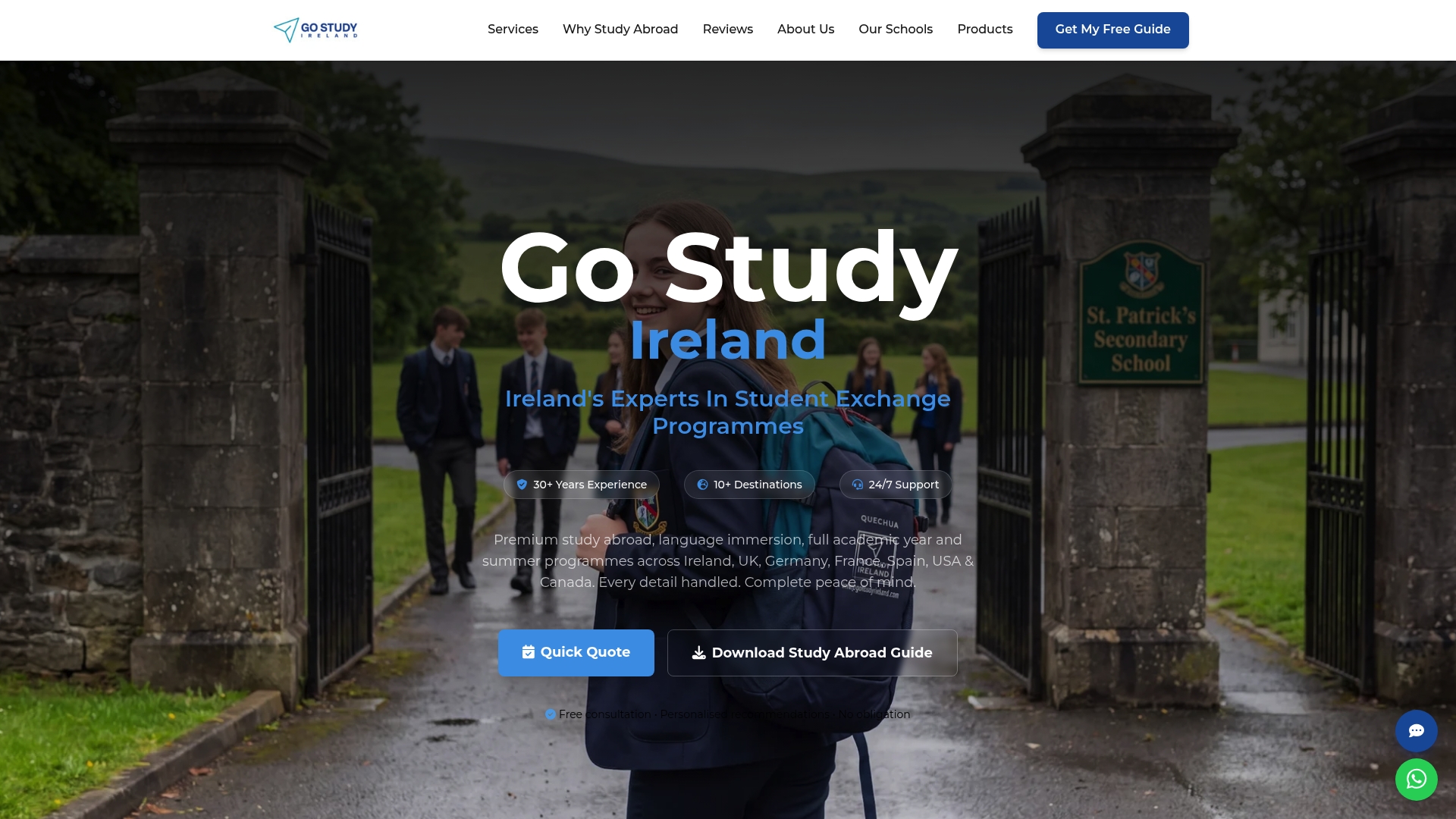
Our academic year placements in Ireland and academic year programmes in the United Kingdom work well as a backup route when a scholarship cycle does not come through in time, and our early-bird academic year booking page is worth checking if your scholarship application lands later than hoped and you still want a confirmed place. For a shorter, lower-commitment introduction to living and studying abroad, our summer camps in Cork, Dublin and Limerick give younger students a first taste before committing to a full year. If you would like to talk through which route fits your timeline and budget, reach out through our services page to start the conversation.
FAQ
How do I get a scholarship to study abroad in high school?
Start by identifying programmes that match your age, nationality and goals, such as YES or FLEX, then register early since most applications open 10 to 12 months before departure. Collect transcripts, references and a tailored personal statement well ahead of the deadline, and prepare for an interview that tests both academic ability and personal qualities like leadership.
How do I get a full scholarship to study abroad?
Fully funded places exist through programmes like CBYX, YES and some ASSIST awards, which can cover tuition, accommodation, meals and sometimes flights, according to the Bureau of Educational and Cultural Affairs. Even these awards often exclude travel, insurance and personal costs, so budget separately for those items regardless of which programme you win.
Which country is easiest to get a scholarship for?
There is no single easiest country, since eligibility and competition depend on your nationality, the host country's quota for that year and the specific programme. Government exchanges like YES and FLEX set country-specific allocations annually, so checking the current cycle's quota for your nationality matters more than looking for a universally "easy" destination.
Which country offers the best full scholarships?
Rather than one standout country, several programmes offer strong fully funded coverage in different places: CBYX for a year in Germany, ESU's Secondary School Exchange for UK boarding schools, and ASSIST's top-tier awards for schools in the United States. The right choice depends on your academic goals, language interests and the specific eligibility rules for your nationality.
What does a high school abroad scholarship typically not cover?
Even generous scholarships commonly exclude flights, visa fees, health insurance, school uniforms and textbooks, as noted in ESU's applicant guidance. Families should plan a separate budget for these costs rather than assuming a "full" scholarship covers everything.
Sources
- Kennedy-Lugar Youth Exchange and Study (YES) — Bureau of Educational and Cultural Affairs
- FY 2026 FLEX Global NOFO — U.S. Department of State
- ESU Secondary School Exchange brochure 2026
- ASSIST scholarships — apply
Authoritative official programme pages and notices to check now
Before applying anywhere, confirm the current cycle's deadlines and quotas directly on the official programme pages, since allocations and timelines change year to year. The YES programme page, the FLEX Global NOFO, the ESU Secondary School Exchange brochure and ASSIST's application guidance all publish their own cycle-specific details, and your national UWC committee will have its own quota and bursary notice separate from the global organisation's general materials.