
You can apply for a UK Student visa if you are 16 or over, hold an unconditional offer from a licensed sponsor, and have a valid Confirmation of Acceptance for Studies. Add proof of funds and, usually, an English test pass, and most applications succeed. The exceptions: wrong-route mistakes (short courses need a different visa) and missing conditional checks like ATAS. Your first move is always the same, secure your CAS, since nothing else can happen until you have it.
TL;DR:
- Applying with a valid CAS and proof of funds is crucial, but you must ensure your sponsor’s license remains active and matches your course details exactly.
- The 28-day bank statement rule is strict; funds must sit untouched for that period and the final day must be within 31 days of your application.
- Different visa routes apply based on age and course type, with specific requirements for child applicants, short-term courses, and degree or non-degree levels.
- Additional documents such as ATAS, TB certificates, parental consent, and accommodation evidence may be required early, depending on your circumstances and nationality.
- Mistakes like timing bank statements, CAS data discrepancies, or incorrect accommodation deductions account for many refusals; early planning can prevent delays.
Table of Contents
- Which visa route applies to you: Student, Child Student or short-term study
- The CAS and course rules: what the Confirmation of Acceptance for Studies must show
- Documents checklist: exactly what to gather before starting the online application
- Financial requirements: how much you must show and how to prove it
- How to apply: online steps, ID verification, biometrics and expected decision times
- Length of stay and conditions while on a Student visa
- Child Student and under-18 applicants: parental consent, accommodation and evidence
- Fees, Immigration Health Surcharge and other costs you must budget for
- ATAS, TB checks and conditional requirements you must confirm early
- Common application pitfalls and expert tips
- Visa interview preparation and commonly asked questions
- How to handle visa refusals and the appeals process
- Travel and re-entry rules while holding a student visa
- Author perspective: planning and support implications for students and families
- How Go Study Ireland can help with placement, document checks and visa logistics
- Sources
- FAQ
Which visa route applies to you: Student, Child Student or short-term study
Most applicants aged 16 and over apply for the Student visa, the main route for anyone with an unconditional offer from a licensed sponsor and a valid CAS. But three routes exist, and picking the wrong one wastes time and money.
If you are 16 or 17, you can apply either for the standard Student visa, if eligible, or for the Child Student route when attending an independent fee-paying school. Anyone 18 or over goes through the Student route by default; there is no alternative for adults.
Short courses sit outside both of these. The Short-term Student (English language) visa covers English courses of up to 11 months and nothing else. It will not work for A-Levels, foundation years, undergraduate degrees, or anything academic, and it carries none of the work rights or dependant provisions of the main Student route. Families looking at a shorter, less formal stay sometimes explore short-term study options in England instead, which sidestep the Student visa system entirely for programmes under a year.
Underneath all three routes sits one non-negotiable filter: the genuine student requirement. UK Visas and Immigration wants evidence that you actually intend to study, not that you are using education as a route into the UK for other purposes. That assessment happens partly through your documents and partly through how consistent your story is, your course level, your previous study history, your stated career plans.
Your sponsor's licence status matters more than most applicants realise. Only institutions holding a valid sponsor licence can issue a CAS, and if that licence is suspended or revoked between your offer and your application, your CAS becomes worthless overnight. Before you commit to a course, check the institution appears on the current sponsor register, not an old prospectus or a third-party agent's list.
Quick route check:
- 18 or over, standard course: Student visa
- 16 or 17, independent school: Child Student visa (or Student, if eligible)
- English language course under 11 months: Short-term Student visa
- Anyone without a sponsor licence holder: no visa route works until that changes
The CAS and course rules: what the Confirmation of Acceptance for Studies must show
Your CAS is not a formality. It is the single document UKVI checks your entire application against, and any mismatch between what it says and what your other paperwork shows can trigger a refusal or a request for more evidence.
A valid CAS contains your sponsor's details, your exact course title and level, the start and end dates, and the fees you have been charged, including any deposit already paid. If your name is misspelled, your course title differs from your offer letter, or the fee figure does not match your bank evidence, sort it with your sponsor's admissions team before you submit anything to the Home Office. CAS records are single-use; once submitted, you cannot simply edit it yourself.
Three things determine whether a course even qualifies for sponsorship in the first place:
- Academic level. The course must sit at RQF level 3 or above in England, Wales, and Northern Ireland, or SCQF level 6 or above in Scotland, unless you are applying for the Child Student route.
- English requirement built into the course. Most degree-level and above courses require English proficiency equivalent to CEFR level B2, tested through an approved method or evidenced through prior qualifications.
- Structure limits. Distance or online elements are capped, and any work placement built into the course cannot exceed the proportion your sponsor's licence permits, typically no more than half the course length for many programmes.
Timing catches people out more often than the content does. A CAS is valid for six months from the date it is issued, so if your sponsor issues it too early relative to your intended application date, it can expire before you use it. Coordinate with your institution on timing to ensure validity, rather than requesting it the moment you accept your offer.
Documents checklist: exactly what to gather before starting the online application
Missing paperwork is the single most common reason applications stall. Before you open the online form, get every item on this list into one folder.
Core documents, everyone needs these:
- Current passport or other valid travel document
- Your CAS reference number
- Identity verification, either through the UK Immigration: ID Check app or biometric enrolment at a visa application centre
Academic and language evidence:
- The academic qualifications your sponsor used to make your offer, transcripts, certificates, degree confirmations
- Secure English Language Test evidence, or documentation proving you are exempt (nationals of majority English-speaking countries, or those with qualifications taught and assessed in English, often qualify for exemption)
- Certified translations for any document not originally in English or Welsh
Financial evidence:
- Bank statements or the equivalent covering the 28-day holding period (covered in detail below)
- Sponsor letters if a parent, guardian, or official body is financing your studies rather than you personally
Conditional documents, only if they apply to you:
- ATAS certificate, for certain postgraduate research and STEM-related subjects
- TB certificate, for applicants from listed countries staying more than six months
- Parental consent letters, for anyone under 18
- Evidence of sponsor-arranged accommodation, where relevant to your funds calculation
According to GOV.UK's official documents guidance, the exact combination required depends on your nationality, course, and personal circumstances, so cross-check against your own situation rather than assuming a generic list applies.
Pro Tip: Scan every document before you travel to your biometric appointment, even ones you think you will not need. If a caseworker requests supplementary evidence later, you will already have a digital copy ready to upload instead of scrambling to track down a paper original from another country.
Financial requirements: how much you must show and how to prove it
You need two figures: your outstanding tuition fees for one academic year, and your maintenance (living cost) allowance. Get either wrong and the refusal follows automatically, regardless of how strong the rest of your application is.
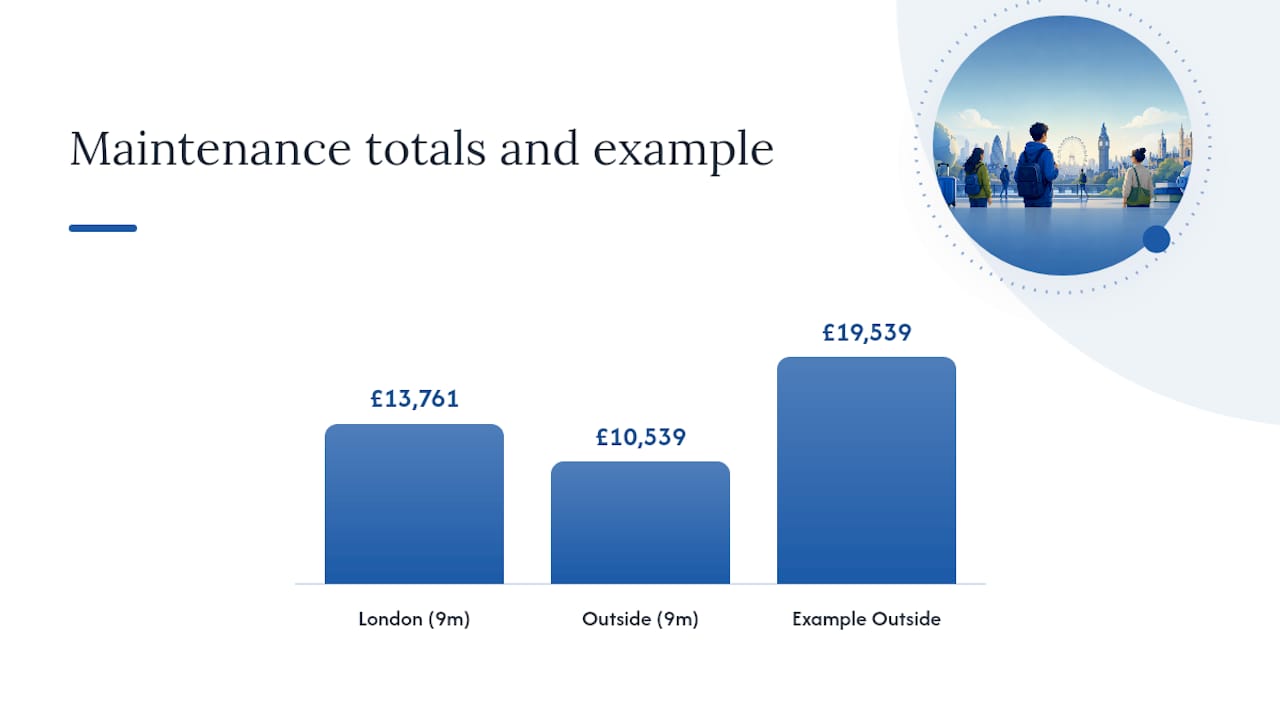
Maintenance rates depend entirely on where you will study. If your course is in London, you must show £1,529 per month; outside London, the figure drops to £1,171 per month. Both rates are capped at a maximum of nine months, even if your course runs longer.
The maths in practice: nine months at the London rate comes to £13,761. Outside London, the same nine-month cap produces £10,539. Add whatever tuition fee balance remains unpaid on top of either figure, and that total is what your bank evidence must support.
So if you owe £9,000 in outstanding fees and you are studying outside London, you need to show £19,539 sitting in your account, not the maintenance figure alone. This is where applicants underestimate their total most often, they check the monthly rate, forget the fee balance, and come in thousands short.
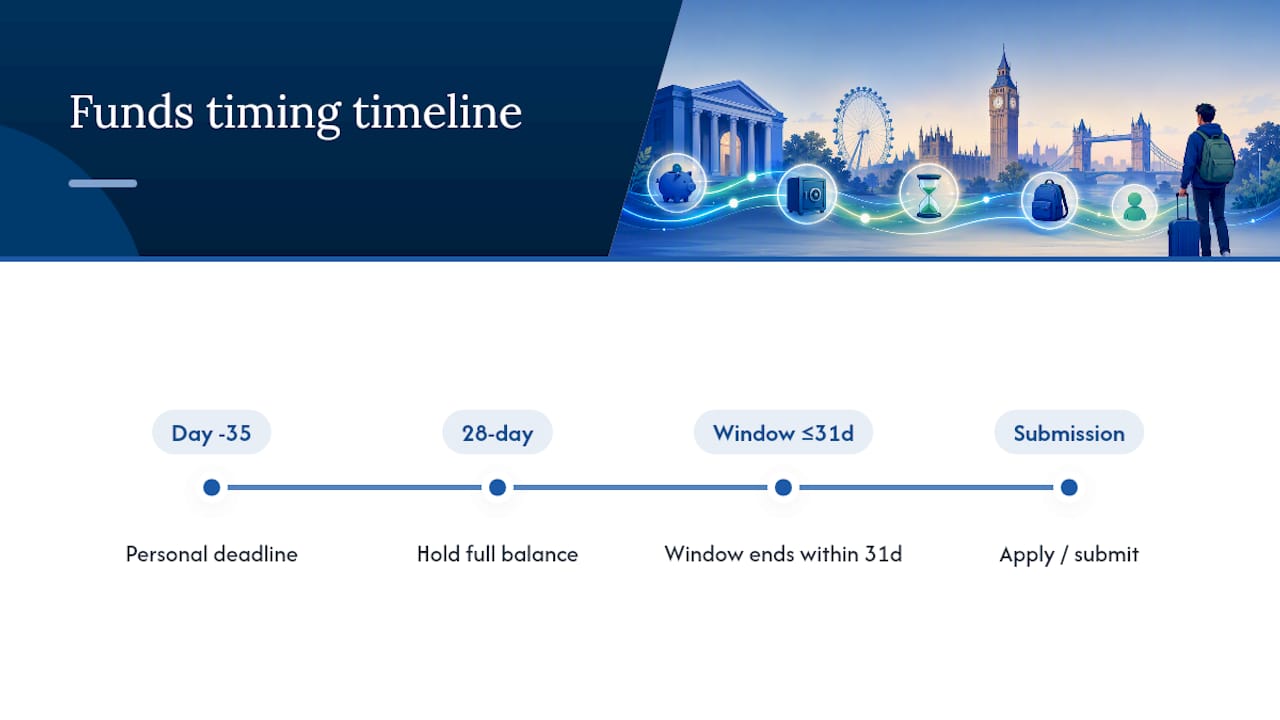
The 28-day rule is where good financial applications quietly fail. Your funds must sit continuously in your account for 28 days, and the final day of that period must fall within 31 days of when you submit your application. Miss that window, even by depositing the right amount a week too late, and the evidence does not count.
A few things soften this:
- If you have held permission to be in the UK for more than 12 months at the point of application, you may be exempt from providing financial evidence altogether.
- Sponsor letters from government bodies, international organisations, or your institution itself can sometimes replace personal bank evidence.
- Scholarship or loan letters count as valid evidence, provided they clearly state amounts and dates.
Check your own case against the official financial evidence guidance before assuming you qualify for any exemption.
How to apply: online steps, ID verification, biometrics and expected decision times
The application itself runs entirely online, and the process follows a fixed order that is worth understanding before you start, because some steps cannot be reversed once completed.
- Complete the online form and enter your CAS reference number exactly as it appears on the document your sponsor issued.
- Pay the application fee and the Immigration Health Surcharge in the same session; the system will not let you proceed to identity verification without this.
- Verify your identity, either by using the UK Immigration: ID Check app on a compatible smartphone, or by booking an appointment at a visa application centre if the app option is not available for your nationality or circumstances.
- Attend your appointment, if required, where staff take fingerprints, a photograph, and verify your original documents against the digital copies you uploaded.
Some applicants are asked for an interview or additional documents after submission. This is not automatically a bad sign, it often just means a caseworker wants clarification on something specific, a fee discrepancy, an unusual study gap, or a course change. Respond promptly and fully; slow or partial responses are what actually damage otherwise strong applications.
Decision times vary by where you apply from. Outside the UK, expect around three weeks. Inside the UK, switching from another visa category, expect closer to eight weeks. Both are typical processing windows, not guarantees, so avoid booking non-refundable flights or accommodation deposits until your decision actually arrives. A rushed booking against an unconfirmed visa is one of the more expensive mistakes families make.
Length of stay and conditions while on a Student visa
Your permission to stay is not a fixed number attached to "the Student visa" as a category, it is tied to your specific course length, plus a period afterwards.
Degree-level students at higher education institutions typically get their course duration plus a further period after completion to transition into work or further study. Below-degree-level courses, foundation years, pre-university programmes, come with tighter limits and usually no post-study extension at all, so check what applies to your specific course level rather than assuming the generous end-of-degree provisions apply to you.
Work rights follow the same logic. Degree-level students at higher education providers generally get more generous permitted working hours than those on below-degree courses, and some short or lower-level courses carry no work rights whatsoever. Dependants, partners and children, are only permitted for certain higher-level, longer courses; most below-degree students cannot bring family members on this route.
Whatever your level, three conditions apply without exception:
- You must remain enrolled with the specific sponsor that issued your CAS, not transfer freely between institutions.
- You must study the exact course named on your CAS, not switch subjects informally.
- Breaching either of these can put your permission to remain at risk, even mid-course.
Child Student and under-18 applicants: parental consent, accommodation and evidence
If you are 16 or 17 and attending an independent, fee-paying school in the UK, the Child Student route usually applies rather than the standard Student visa. Younger children below 16 can only use this route, never the adult Student category.
Appendix Child Student sets out its own points table, distinct from the main Student route, and it demands extra evidence that adult applicants never need to worry about.
Parental consent is the part families most often underestimate. UKVI generally expects three separate consents, not one blanket letter:
- Consent to the visa application itself
- Consent to travel to the UK
- Consent covering care and living arrangements while the child is in the UK
Each consent typically needs to come from everyone with parental responsibility, and you will usually need to provide evidence of the relationship, birth certificates, custody documentation where relevant, alongside the consent letters themselves.
Maintenance calculations differ depending on living arrangements too. A child boarding at school has funds requirements calculated differently from one living with a relative or in independently arranged accommodation, so check the specific figures against your own arrangement rather than assuming the standard Student route maintenance rates apply directly.
Fees, Immigration Health Surcharge and other costs you must budget for
Two costs sit on top of tuition and living expenses, and both are compulsory before your visa is even considered.
From 8 April 2026, the Student visa application fee is £558. The student Immigration Health Surcharge annual rate published in the same fee schedule sits at £776.
The IHS is not simply £776 flat. It is calculated per year (or part-year) of your visa length, so a three-year degree course produces roughly three times that annual figure, paid upfront in full when you submit your application. Use the official IHS calculator to get the exact figure for your specific course length rather than estimating from the annual rate alone, since part-years and rounding rules can shift the total.
Child applicants pay the same application fee structure as adults on this route, though family circumstances and sponsor arrangements can occasionally affect who actually settles the bill. Fee tables change periodically, so verify the live figures on the official Home Office schedule before you pay rather than relying on any figure quoted in an older article, agent brochure, or forum post.
ATAS, TB checks and conditional requirements you must confirm early
Two conditional checks catch out applicants who leave them until the last minute, and both can add weeks to your timeline if you discover them late.
ATAS, the Academic Technology Approval Scheme, applies to certain postgraduate research and teaching subjects, mostly in science, engineering, and technology fields with security-sensitive applications. If your course requires it, you must obtain the ATAS certificate before you apply for your visa, not after. Applicants who wait until they have a CAS in hand often find themselves stuck, since ATAS processing can take several weeks on its own.
TB certificates apply if you are travelling from a country on the UK's listed-country register and plan to stay more than six months. You get this tested at an approved clinic in your home country, and the certificate needs to be current at the point of application.
Beyond these two, general suitability grounds, previous immigration breaches, criminal record issues, prior refusals, can also affect your application regardless of how strong your academic case is. Check route-specific guidance directly on GOV.UK if any of these circumstances apply to you.
- Check ATAS requirements the moment you have your course title, before you request your CAS
- Book TB testing early if you are from a listed country, clinic appointments can have waiting lists
- Declare any past immigration history honestly rather than hoping it goes unnoticed
Common application pitfalls and expert tips
Three mistakes account for a disproportionate share of avoidable refusals, and all three are entirely within your control.
The first is timing bank statements incorrectly. The 28-day holding rule is unforgiving: if you deposit a large sum eight days before applying because a relative just transferred funds, that money has not been held long enough, no matter how much is sitting there. Count backwards from your planned application date and make sure the full 28-day window closes within 31 days of submission, and recheck this whenever your CAS date or biometric appointment shifts.
The second is CAS data mismatches. If your CAS lists your course as starting a week later than your offer letter states, or your name has a typo, that discrepancy needs correcting with your sponsor's admissions office before you submit, not explained away afterwards.
The third involves accommodation deductions. Only accommodation deposits paid directly to your sponsor institution can typically be offset against your maintenance requirement, and only within published caps. Payments made to a private landlord or a third-party agency generally do not receive the same treatment, so do not assume any accommodation cost reduces your required funds figure unless your sponsor is the one holding that money.
Pro Tip: Set a personal deadline that is 35 days before your planned application date to have your full funds sitting untouched in your account. That buffer covers the 28-day rule plus a margin for any unexpected delay in gathering your other documents.
Visa interview preparation and commonly asked questions
Not everyone gets called for an interview, but if you are, preparation matters more than most applicants expect. Interviews, when they happen, tend to focus on verifying the genuine student requirement rather than catching people out on technicalities.
Expect questions about why you chose your specific course and institution, how it connects to your previous studies or career plans, and how you intend to fund yourself throughout. Caseworkers also commonly ask about your ties to your home country, family, property, ongoing commitments, since part of the assessment considers whether you intend to leave the UK once your permission expires.
Practical preparation beats memorised answers. Know your course structure well enough to explain it without hesitation, understand exactly where your funds come from and be ready to explain any large or unusual transactions in your bank history, and be honest about your future plans rather than giving an answer you think sounds better. Inconsistency between your interview answers and your written application is a bigger red flag than an unconventional answer honestly given.
Bring copies of everything, even documents you have already submitted digitally. If asked something you genuinely do not know, such as an obscure detail about your sponsor institution's accreditation, say so rather than guessing; caseworkers generally respond worse to invented answers than to an honest "I'm not sure, but I can find out."
How to handle visa refusals and the appeals process
A Student visa refusal is not usually the end of the road, but your options depend entirely on why you were refused.
Most Student visa refusals do not carry a formal right of appeal to a tribunal; instead, you typically have the option of an administrative review, a request for the Home Office to check its own decision for a case-working error, factual mistakes, documents overlooked, or a rule misapplied. Administrative review has strict, short deadlines, so act immediately once you receive a refusal letter rather than waiting to consider your options.
If the refusal stemmed from something fixable, insufficient funds held for the wrong period, a missing document, an expired CAS, your fastest route back is often a fresh application rather than review or appeal, provided you can correct the underlying issue. Read your refusal letter closely: it specifies the exact reason, and that reason dictates whether reapplying, requesting review, or seeking legal advice is your best next step.
For anything involving a suitability refusal, allegations around deception, previous breaches, character issues, get advice from an immigration adviser regulated by the Office of the Immigration Services Commissioner before you do anything else. These refusals carry longer-term consequences for future applications and are not the kind of issue to navigate alone from a general guide.
Travel and re-entry rules while holding a student visa
Holding a valid Student visa does not mean unrestricted travel in and out of the UK, though the rules are more flexible than many applicants assume.
You can generally travel outside the UK and return during your course, provided your visa remains valid and you are not attempting to return after an absence that breaches your course attendance requirements. Most sponsors track attendance closely, extended, unexplained absences can affect your standing with them independently of your immigration status, and persistent absence can even prompt your sponsor to withdraw their sponsorship.
Re-entering the UK, you will need your passport, your visa or the biometric residence permit or eVisa confirming your status, and you should be ready to explain your study plans if questioned at the border, particularly after a longer trip home. Border officials occasionally ask current students about their course and return intentions, not as a hostile check, but as a routine part of assessing anyone re-entering on a study-based visa.
One detail that surprises people: if your visa is close to expiry when you travel, or if your course is ending and you have not yet secured further permission, re-entry can become complicated. Plan international travel around your course calendar and your visa expiry date, not just around holidays or family visits, and avoid booking a return flight for a date that falls suspiciously close to when your current permission runs out.
Author perspective: planning and support implications for students and families
The rules themselves are not complicated. What trips families up is sequencing, chasing a CAS before checking sponsor licence status, gathering bank statements without understanding the 28-day rule, booking flights before a decision arrives. Every genuinely difficult case I have seen traces back to timing, not eligibility.
Some families prefer having a single service coordinating placement, accommodation, and visa logistics as one process rather than dealing with multiple separate contacts. That is not a substitute for reading the official rules yourself. But a checklist followed early, CAS confirmed, funds held on time, documents translated before they are needed, resolves the overwhelming majority of delays before they happen.
— Eugeni
How Go Study Ireland can help with placement, document checks and visa logistics
Go Study Ireland exists for exactly the moment you are at now, holding an offer, staring at a documents list, and wondering whether your CAS, bank statements, and accommodation evidence will actually line up. Specialized services can manage placement, accommodation, and visa logistics as one coordinated process, sometimes offering local support and carefully vetted host families.
For readers weighing a full academic year in the UK rather than a shorter programme, the Academic Year in the United Kingdom service covers placement matching alongside the practical groundwork, CAS coordination, accommodation, and day-to-day support once your student arrives. Those applying independently for degree-level study can also get help through the University Placement service, which assists with documentation and application coordination rather than leaving you to interpret Home Office guidance alone. This is one option among several routes into UK study, not a guaranteed outcome, but for families who want someone checking the details alongside them, it is worth a direct enquiry. Get in touch through the Academic Year UK page to discuss your specific course and timeline.
FAQ
What are the new rules for the UK Student visa in 2026?
The core framework, age 16+, unconditional offer, valid CAS, financial evidence, remains unchanged, but the application fee rose to £558 from 8 April 2026 alongside a revised Immigration Health Surcharge rate. Always check the live fee schedule before paying, since these figures are updated periodically.
How much money do you need for a UK Student visa?
You need your outstanding tuition fees for one year plus maintenance at £1,529 per month in London or £1,171 outside London, capped at nine months. That produces a maintenance-only cap of £13,761 in London or £10,539 outside London, before adding your remaining fee balance.
How much bank balance is required for a UK Student visa?
Your bank balance must cover the combined total of tuition fees owed and your maintenance cap, and it must be held continuously for 28 days, with the final day falling within 31 days of your application date. A balance that only briefly reaches the required amount does not satisfy this rule.
How many years does the UK give for a student visa?
There is no single fixed length; permission is tied to your specific course duration plus, for many higher-level courses, a period afterwards to transition into work or further study. Below-degree courses generally receive shorter permission with no equivalent extension, so check the terms attached to your specific course level.
Can Go Study Ireland help with my Student visa application?
Go Study Ireland does not process visas on your behalf, but its Academic Year in the United Kingdom service supports the placement, accommodation, and logistics side of your application, including coordination around your CAS and documentation. It is one option for families who want hands-on support alongside the official process, not a replacement for it.