
Pack a capsule wardrobe you can rewear on a seven-to-ten-day cycle, split everything across a two-bag or three-bag system, and never let your passport, visa, medication, phone, chargers, or a spare outfit out of your hand luggage. Everything else, from jumpers to spare shoes, can go in the hold. If it's replaceable, check it. If it isn't, carry it.
TL;DR:
- Pack only the essentials for a seven-to-ten-day rotation, relying on laundry to avoid overloading your luggage with unnecessary items.
- Keep all crucial documents, medication, and valuables in your hand luggage with digital backups to prevent loss or theft disruptions.
- Clarify what your accommodation provides, like bedding and laundry, to avoid packing redundant items and reduce weight.
- Use a bag-by-bag system with designated roles for daily essentials, safety items, and bulk clothing to stay organized and prevent lost items.
- Consult official program guidelines and airline limits before packing to ensure compliance with rules and avoid last-minute surprises.
Table of Contents
- Carry-on essentials and arrival-day documents
- Building a capsule wardrobe for a semester abroad
- Electronics, adapters and staying connected abroad
- Toiletries, medication and health essentials
- The bag-by-bag system: backpack, carry-on, checked case
- Money, banking and financial preparations
- What not to pack: common mistakes to avoid
- Pre-departure timeline: what to do and when
- How programme support reduces packing uncertainty
- Specialty items for lab work, art, and practical courses
- Cultural considerations and dressing appropriately
- Security tips for packing valuables
- Packing gifts and bringing souvenirs home
- Handling liquids and toiletries through airport security
- An adviser's short take: why lighter packing beats over-preparing
- Let Go Study Ireland handle the logistics you can't pack for
- Official resources worth checking before you travel
- Sources
- FAQ
Carry-on essentials and arrival-day documents
Your hand luggage isn't just for the flight. It's your insurance policy against a delayed bag, a missed connection, or a border official who wants to see paperwork you didn't think to keep handy. Airlines lose bags. They rarely lose passengers, so anything you genuinely cannot replace at your destination belongs on your body or in the bag under the seat in front of you.
Carry your passport, visa or residence permit, acceptance letter, insurance certificate, and photocopies of all of it in your hand luggage, and keep digital scans backed up to cloud storage as a second line of defence. A photo on your phone is not a backup. If your phone dies or gets stolen on day two, a cloud folder you can access from any browser is the difference between a minor inconvenience and a genuine crisis.
Your carry-on checklist should include:
- Passport, visa/residence documents, and physical photocopies of each
- Acceptance letter, insurance certificate, and emergency contact details
- Phone, laptop, and all chargers (no exceptions here)
- One complete change of clothes, including underwear and socks
- A small amount of local currency plus one backup card
- Prescription medication in original packaging, with a doctor's note if needed
- Any small, high-value items (jewellery, an old phone as backup, headphones)
On connectivity, buy an eSIM before you leave rather than gambling on airport queues or hunting for a SIM shop on arrival, jetlagged and directionless. Most modern phones from the last few years support eSIM, and setting it up from home means you land already able to call a taxi, check a map, or message your host family the moment you touch down. If your phone is locked to your home network, sort that out weeks in advance. It's a five-minute job at home and a genuine headache abroad.
Pro Tip: Screenshot your accommodation address and your programme adviser's phone number before you board. Airport WiFi is unreliable, and the thirty seconds it takes to find a document in a folder feels much longer when you're standing in an unfamiliar arrivals hall.
Building a capsule wardrobe for a semester abroad
The instinct to pack for every day of the semester is the single biggest mistake first-time study abroad students make. You don't need thirty outfits. You need a tight, repeatable rotation that covers seven to ten days, all of it mixing and matching, because you will do laundry roughly once a week regardless of how much you bring.
For a moderate climate, a solid capsule looks like this:
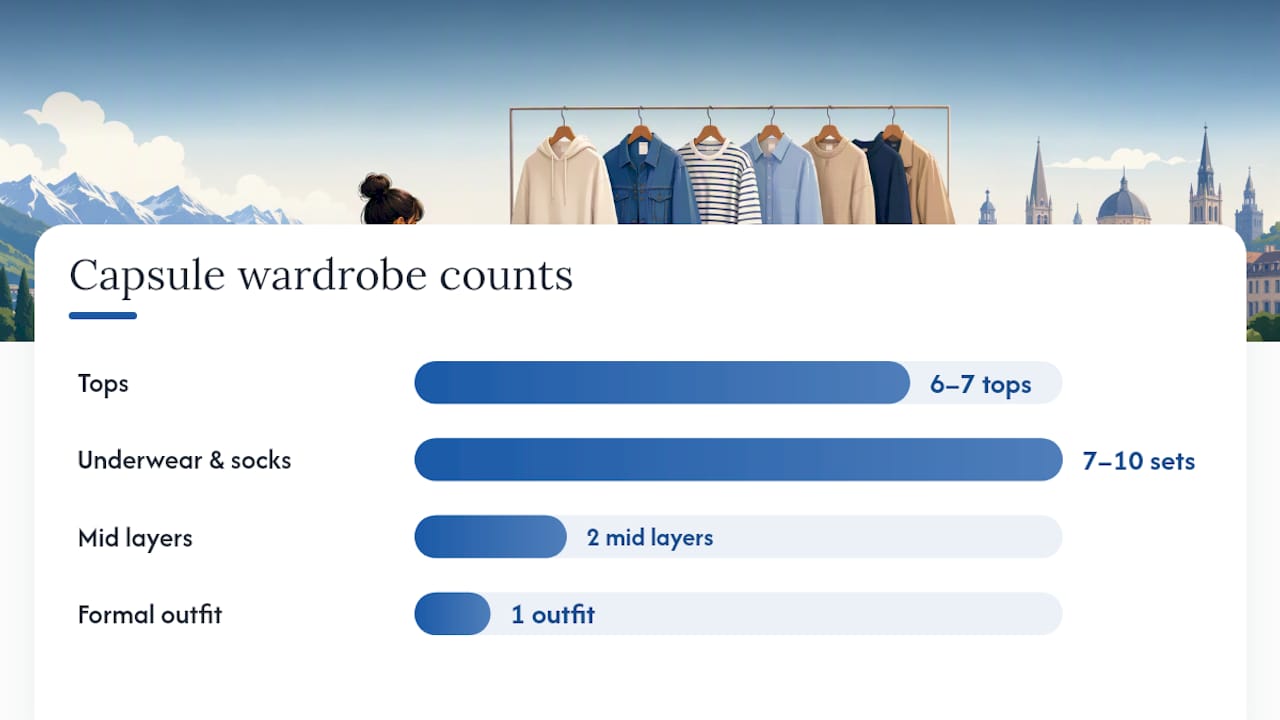
- 6 to 7 tops (mix of short and long sleeve)
- a few bottoms (jeans, trousers, one skirt or shorts if relevant)
- 7 to 10 sets of underwear and socks
- a couple of mid layers (jumpers, cardigans, a hoodie)
- a waterproof or wind-resistant jacket
- a small number of shoes with different uses: comfortable daily shoes, smarter shoes, and trainers
- 1 formal outfit for interviews, presentations, or a nice dinner
- Sleepwear and one swimsuit if relevant
Neutral colours that all coordinate with each other stretch a small wardrobe further than anything trendy, a point study abroad packing guidance from university programmes repeats for good reason. Layering wins over bulk every time. Three thin layers give you more temperature flexibility than one thick coat, and they pack down to a fraction of the size.
For cold destinations, prioritise thermal base layers, waterproof boots, and a genuinely warm coat over quantity. For warm climates, swap the thermals for breathable fabrics and SPF, and bring fewer layers overall since you'll rely on air-conditioning and shade rather than insulation.
Shoes are the heaviest, most awkward items you own, so wear your bulkiest pair on the plane rather than packing it. That alone can save close to a kilo of allowance for something else.
Pro Tip: Lay everything out on your bed before you pack, then remove a third of it. Most returning students say they wish they'd packed less, not more.
Electronics, adapters and staying connected abroad
Bring your phone, laptop, headphones, and chargers for each. Leave duplicate devices, an old tablet "just in case," or a hairdryer at home. Most electrical appliances weigh more than they're worth carrying across an ocean, and you can buy a cheap one locally in an afternoon.
Before you pack an adapter, check the voltage printed on your charger's brick. Most modern phone and laptop chargers run on 100 to 240 volts, meaning they're dual-voltage and only need a plug shape adapter, not a bulky voltage converter. Buy your travel adapter before you leave home. Airport shops mark them up considerably, and you don't want to be hunting for one at 6am with a flight to catch.
- One universal travel adapter (buy before departure, not at the airport)
- Phone and laptop chargers, plus a portable power bank
- A short extension lead with multiple sockets, useful in shared student housing
- A cable organiser or small pouch to stop chargers turning into a tangled mess
Buy an eSIM before departure if your destination and provider support it. It saves you the arrival-day scramble of finding a shop, and it means you land connected.
Toiletries, medication and health essentials
Bring roughly a three-month supply of any prescription medication in its original packaging, along with a doctor's letter covering the dosage and reason for use, particularly for controlled substances. Check your destination's specific import rules before you fly, since what's legal at home isn't always legal to bring in.
Pack a small health kit rather than a full medicine cabinet:
- Pain relief and antihistamines in travel-sized packaging
- Blister plasters (your new shoes will need them)
- Antiseptic cream or wipes for minor cuts
- A printed copy of your insurance policy and emergency contact numbers
Skip full-size toiletries and period products. Buy them locally once you've settled in. Every country sells shampoo.
Pro Tip: Keep your insurance certificate and one photocopy of your prescription in your carry-on, not your checked bag. If a pharmacy needs proof of your medication, you don't want it sitting in cargo.
The bag-by-bag system: backpack, carry-on, checked case
Assign each bag a job before you start packing, rather than throwing things in and hoping they fit. A bag-by-bag system built around three distinct roles cuts down on lost items and makes weekend trips far simpler once term starts.
- Daypack carries what you touch constantly: phone, headphones, water bottle, a notebook, snacks for the journey.
- Carry-on holds your safety net: documents, chargers, one change of clothes, medication, and anything irreplaceable.
- Checked case takes the bulk: the rest of your capsule wardrobe, shoes, and any bedding or textbooks you're bringing.
Inside the checked case, packing cubes keep clothing compressed and organised by category, so you're not unpacking the whole bag to find one jumper. Load heavier items near the wheels for balance, and lighter ones on top.
- Daypack: phone, wallet, headphones, water bottle, snacks
- Carry-on: documents, chargers, spare outfit, meds, one valuable item
- Checked case: bulk clothing, shoes, packing cubes, any bedding
Once term begins, your daypack becomes your weekend travel bag too. A capsule wardrobe designed for a week-long rotation at home doubles neatly as a weekend-trip wardrobe abroad, so you're not buying a second set of travel gear halfway through the semester.
Money, banking and financial preparations
Carry a small amount of local currency, enough to cover a taxi and a meal on arrival, plus a backup in a major currency like US dollars or euros in case a currency exchange is closed.
- Small amount of local currency for day one
- One backup card from a different bank, kept separately from your main wallet
- Emergency card cancellation numbers, written down or saved offline
- A copy of your card numbers stored somewhere other than your wallet
If you're staying for a full academic year, ask your programme adviser whether opening a local bank account makes sense. It usually simplifies rent, phone contracts, and everyday spending far more than repeatedly paying foreign transaction fees.
What not to pack: common mistakes to avoid
The heaviest items in most students' bags are the ones they never needed. Full-size shampoo bottles, a second pair of "just in case" trainers, a stack of textbooks, and small kitchen appliances all eat weight allowance for very little benefit.
- Full-size toiletries (buy travel-sized or purchase on arrival)
- Duplicate pairs of shoes (you only need three)
- Heavy textbooks (check if digital versions or local copies exist)
- Hairdryers, kettles, or other small appliances (cheap to buy locally, often incompatible with local voltage anyway)
These items are heavy, easily replaced, and in the case of some appliances, a genuine fire risk on the wrong voltage. If you truly need something bulky, such as specialist equipment, ask your programme whether it's easier to ship it ahead rather than carry it.
Pre-departure timeline: what to do and when
Spreading your preparation over months rather than cramming it into the final week keeps the process manageable and stops you making decisions at 2am the night before your flight.
- Six months out: apply for or renew your passport, start your visa application, and check vaccination requirements for your destination.
- Three months out: confirm your insurance policy, book flights, and begin your capsule wardrobe list.
- One month out: collect your visa if approved, notify your bank of travel dates, and buy your eSIM.
- Two weeks out: photocopy every key document, download offline maps of your destination city, and confirm what your accommodation provides.
- 48 hours out: weigh your bags, checking against your airline's checked luggage allowance, which typically caps around 23kg with a carry-on limit closer to 8 to 10kg. Leave 2 to 3kg of spare weight for the souvenirs you'll inevitably bring home.
Double check baggage limits for every leg of your journey, not just the main flight. A budget connecting flight sometimes has a stricter carry-on size limit than your long-haul leg.
How programme support reduces packing uncertainty
Half of over-packing comes from not knowing what's already provided. Before you finalise your list, ask your programme adviser directly about bedding, laundry access, and kitchen equipment at your accommodation.
- Is bedding supplied, or do you need to bring your own sheets?
- Is there laundry access on-site, or a launderette nearby?
- Are pots, pans, and basic kitchen equipment included?
- Will someone meet you at the airport, or do you need to arrange transport?
Vetted host families and 24/7 local support exist precisely to answer these questions before you pack a single bag, not after you arrive short a duvet.
Specialty items for lab work, art, and practical courses
Standard packing advice rarely covers what happens when your course requires equipment beyond clothes and a laptop. If you're studying art, design, lab sciences, or a practical trade, check your programme's supply list well before you pack, since some items are genuinely worth bringing and others are a waste of luggage space.
Art and design students often benefit from bringing a small kit of personal tools, favourite brushes, a specific sketchbook, or a graphics tablet, since replacing familiar equipment abroad can be expensive or simply unavailable in the same brand. Bulkier supplies like paints, canvases, or large portfolios are usually better bought locally once you know what your course actually requires.
Lab and science students should never assume they need to bring safety goggles, lab coats, or specialist equipment. Almost every host institution provides these on-site, and airlines can be twitchy about anything resembling chemical equipment or sharp tools in hand luggage. Ask your department directly rather than guessing, and confirm what's supplied against what you're expected to source yourself.
If a course genuinely requires a specific calculator model, instrument, or textbook unavailable locally, pack it in your checked case, well protected, and email your department in advance to confirm it's actually necessary. Programme coordinators would rather answer that question twice than have a student turn up with the wrong equipment or, worse, none at all.
Cultural considerations and dressing appropriately
What counts as ordinary clothing at home doesn't always translate abroad, and getting this wrong on day one is an easy way to feel awkward before you've even started classes. Research your destination's general dress norms before you pack, particularly around religious sites, formal academic settings, and everyday street wear.
Some countries expect more modest clothing in public than you might be used to, particularly around shoulders and knees, while others are considerably more relaxed than home. A few practical additions solve most of this: a lightweight scarf or shawl that can cover shoulders at a moment's notice, one pair of trousers that reads as smart rather than casual, and shoes you'd be comfortable wearing into a place of worship or a formal meeting.
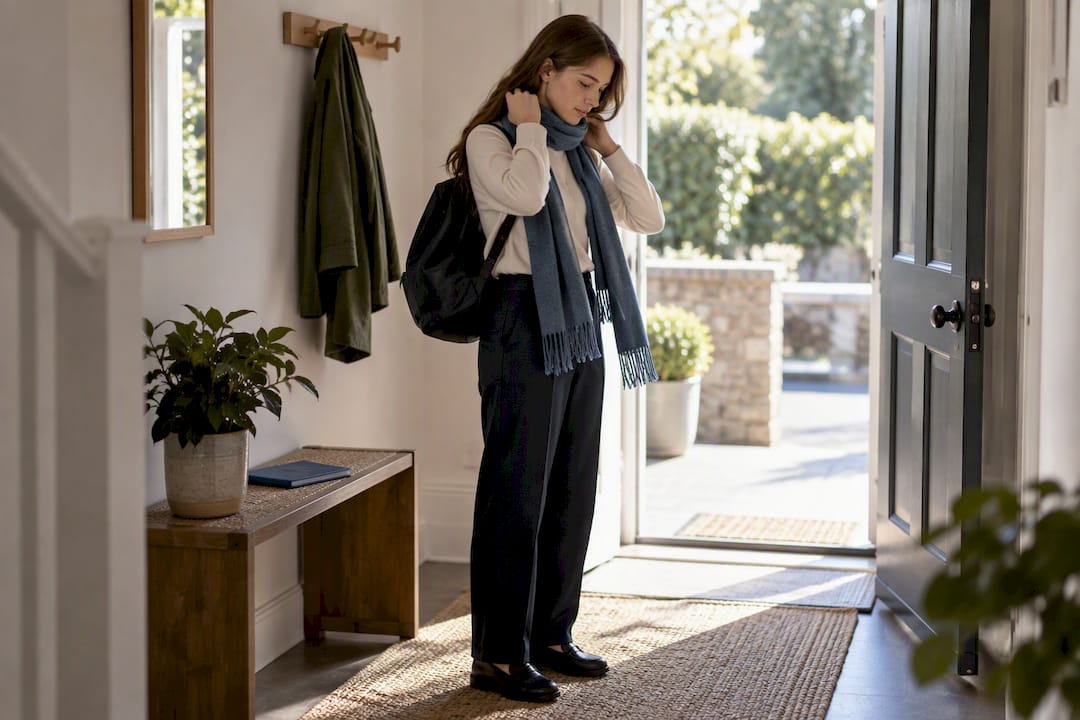
Academic dress codes vary too. Some universities expect smarter clothing for presentations or meetings with professors than you'd wear to a lecture at home, so that one formal outfit in your capsule wardrobe earns its place more often than you'd expect.
None of this means over-packing for every possible scenario. It means choosing a handful of versatile pieces that flex between casual and slightly more formal, rather than assuming your usual wardrobe translates perfectly to a different culture.
Security tips for packing valuables
Anything you'd be devastated to lose needs to travel on your body, not in a bag that leaves your sight. That includes your passport, cards, phone, and any jewellery with sentimental or financial value.
A money belt or a bag with a slash-resistant strap worn across your body, rather than a backpack with easy access from behind, cuts down opportunistic theft risk considerably in busy airports, train stations, and tourist areas. Avoid packing anything valuable, cash, jewellery, electronics, in your checked luggage. Checked bags occasionally go missing, and airline compensation for lost valuables is usually capped far below their real worth.
Split your money and cards across two locations rather than carrying everything in one wallet. If you lose one, you're not stranded without any funds at all. Photograph the contents of your wallet, cards included, before you travel, so you have a record if anything needs to be cancelled or reported.
Leave anything irreplaceable at home. Family heirlooms and once-in-a-lifetime jewellery are not worth the risk of loss, theft, or damage over a semester abroad.
Packing gifts and bringing souvenirs home
If you're bringing small gifts for a host family, pack something compact and representative of home rather than anything fragile or bulky. Local food items, small crafts, or something specific to your home region tend to land better than generic souvenirs, and they take up minimal luggage space.
Leave the wrapping paper at home. Gifts sometimes need to be opened for airport security, and wrapping just adds weight and hassle for no benefit. A small gift bag works fine.
For the return journey, this is exactly why leaving 2 to 3kg of spare weight in your checked case matters. Students consistently underestimate how much they'll want to bring home, from local snacks to small souvenirs for family, and running out of allowance on the way back is a frustrating way to end a semester abroad.
Handling liquids and toiletries through airport security
Airport liquid rules catch out even experienced travellers, so it's worth a quick refresher before you pack your carry-on. Any liquid, gel, or paste in your hand luggage generally needs to fit in containers of 100ml or less, all packed together in a single clear resealable bag.
Decant anything over that limit into travel-sized bottles, or better yet, pack full-size toiletries in your checked case where the 100ml rule doesn't apply. Anything you genuinely need during the flight itself, hand sanitiser, lip balm, contact lens solution, should sit in your liquids bag within easy reach, not buried at the bottom of your carry-on.
Rules vary slightly by country and airport, so check your departure airport's specific guidance a few days before you fly rather than assuming every airport follows an identical standard.
An adviser's short take: why lighter packing beats over-preparing
The students who arrive calmest are almost always the ones who packed the least. Weigh your bags at home and leave 2 to 3kg of spare capacity, then trust that basics like shampoo and phone chargers exist wherever you're going. Buying a jumper abroad is a five-minute errand. Lugging one you never wore across an ocean is not.
— Eugeni
Let Go Study Ireland handle the logistics you can't pack for
A packing list solves half the problem. The other half is everything you can't fit in a suitcase: the visa paperwork, the host family vetting, the question of who picks you up at arrivals when your flight lands at midnight in a country you've never visited. Some student exchange companies specialise in managing visas, accommodation, and school placement so families can spend their energy on the wardrobe list, not the logistics.

Before you finalise a single bag, ask your programme adviser two things: what bedding and laundry access actually look like at your accommodation, and exactly how airport pickup is arranged on arrival day. Both answers change what you need to pack, and both are exactly the kind of detail Go Study Ireland's 24/7 local support is built to confirm before you travel, not after you land confused.
If you're weighing up a full academic year rather than a shorter stay, the Academic Year in Ireland programme includes vetted host families and ongoing support throughout the placement. For families exploring a shorter introduction first, the university placement service covers the same end-to-end approach for students heading into higher education abroad. Get in touch to talk through what your specific placement provides before you start packing.
Official resources worth checking before you travel
Cross-check your own list against a university programme's official packing guidance and your airline's current baggage allowance page, since rules and limits shift year to year. Always confirm visa and health requirements directly with your destination country's embassy.
Sources
- Packing List – Education Abroad (University of Illinois)
- 2026 Summer/Fall study abroad handbook (Meredith College)
- Study-abroad
- Study Abroad Packing List: Bag-by-bag guide – Voyage Luggage
FAQ
What is the 5-4-3-2-1 packing rule?
It's a rough guide for a week-long trip: five tops, four bottoms, three pairs of shoes, two accessories, and one formal outfit. For a full semester abroad, this translates directly into a capsule wardrobe built for repeated laundry cycles rather than one outfit per day.
What is the 3-3-3 rule for packing?
This method suggests three tops, three bottoms, and three pairs of shoes as a minimalist baseline, then adding layers and essentials on top. It works well as a starting point for study abroad, though most students find a slightly larger rotation, closer to the seven-to-ten-day capsule described above, more practical for a semester.
What is the 3-5-7 rule in packing?
Definitions vary slightly, but the general idea is three outfits for casual wear, five for everyday activities, and seven total pieces you can mix and match across a week or more. It's another variation on the same core principle behind a capsule wardrobe: fewer pieces, more combinations.
What are the best things to pack for a study abroad trip?
Prioritise your passport, visa, insurance documents, medication, and one full change of clothes in your carry-on, then build a capsule wardrobe designed for a seven-to-ten-day rotation of mix-and-match clothing pieces for checked luggage. Leave full-size toiletries, spare appliances, and duplicate shoes at home, and buy those items locally instead.
How much does a Go Study Ireland summer camp cost?
Prices vary by location: Summer Camp in Cork costs 2280 EUR, Dublin costs 2330 EUR, and Limerick costs 2310 EUR, all one-off per person, as listed on the summer camps page. Academic year placements vary, with the Academic Year in Ireland priced between 13,500 and 24,800 EUR per year depending on the programme chosen.